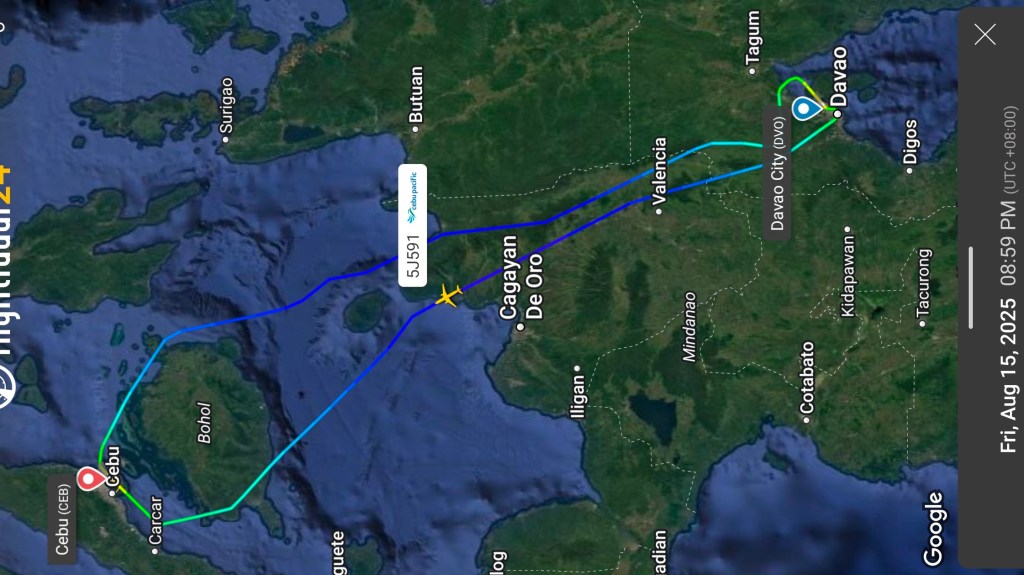
Heavy monsoon rains and virtually zero visibility forced Cebu Pacific flight 5J591 to abort its landing at Francisco Bangoy International Airport (Davao City) on Friday, August 15, 2025. The Cebu-to-Davao flight climbed out just before touchdown, catching passengers by surprise. Flight tracking records show the 11:35 AM Cebu departure on Aug. 15 was listed as scheduled for Davao but logged no arrival time, consistent with the aircraft diverting back to Mactan-Cebu International Airport. Civil aviation authorities had warned of deteriorating weather that day – the southwest monsoon (Habagat) and a tropical low were causing torrential downpours across Mindanao and the Visayas. The CAAP reported nearly 100 domestic flights canceled or delayed that week due to flooding and runway hazards, and noted that at least one flight was redirected on Aug. 15 because of “low visibility”. In this case, the captain chose to go around from only about 30 feet above the runway when visibility suddenly dropped. All 180 passengers and crew later disembarked safely in Cebu; no injuries were reported.
Passenger accounts highlight the abruptness of the maneuver. One traveler, Rom Manuel, later posted on social media that “the landing gear was ready… then we noticed the plane was taking off again,” describing the sudden climb-out just meters above the tarmac. Cabin crews quickly reassured everyone; the First Officer announced the diversion was purely for safety reasons in the treacherous weather. Cebu Pacific stressed that its pilots are trained to prioritize safety. Aviation experts note that go-arounds are standard procedure whenever conditions fall below landing minimums. “It’s often a sudden change in weather” – a squall or a wind shift or visibility dropping – that triggers a go-around. In fact, one safety analyst quipped that “it’s better to go around a hundred times than to force a landing that isn’t safe”. In practice, pilots immediately apply full power, retract the gear, and climb away to a safe altitude, coordinating with air traffic control for the next steps. These maneuvers may feel abrupt to passengers, but they are routine and designed to keep everyone safe.
In aviation terms, the crew of 5J591 simply executed a precautionary rejected landing. Similar situations have occurred before under Davao’s stormy skies. For example, on November 30, 2024 an ATR 72-600 en route to Davao encountered heavy rain and aborted its approach, diverting instead to Cagayan de Oro. The flight tracking data from that incident (see image below) shows how the plane climbed steeply out of its descent path when the weather closed in. In all such cases, pilots follow a careful checklist: announce “go-around,” pitch up, retract gear, and prepare for another attempt or diversion. These actions ensure the aircraft can re-attempt the approach later or land at an alternate field rather than risk landing in zero-visibility conditions.
 Ilonggo Traveler
Leave a comment