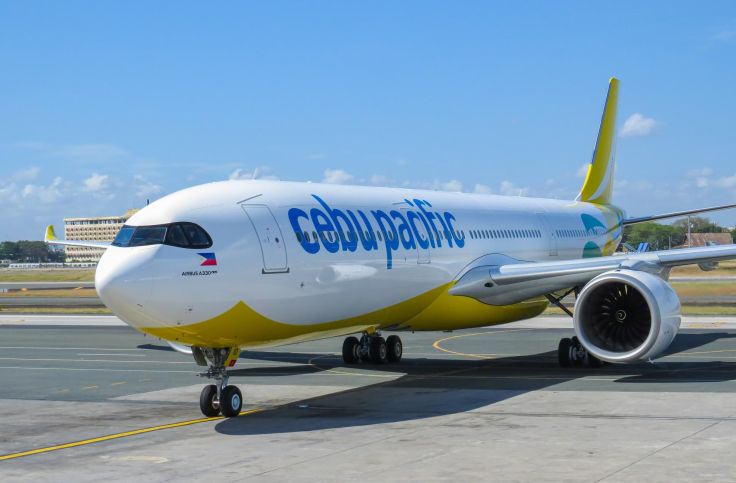
Cebu Pacific will deploy a 459-seat Airbus A330-900neo on its Manila–Iloilo route starting Oct. 26, 2025. The carrier will operate this wide-body jet seven times (7x) a week, greatly increasing capacity on the route. Iloilo International Airport – Western Visayas’s first international-standard airport and primary gateway – is equipped to handle such aircraft, so these new flights mark the first regular wide-body commercial service for the region. The expanded service responds to rising demand: Cebu Pacific expects to offer more seats and possibly lower fares while improving the travel experience.
The A330-900neo is a modern, fuel-efficient wide-body aircraft. It carries 459 passengers and burns about 25% less fuel per flight than earlier-generation jets, significantly reducing carbon emissions. The quieter, more efficient design also lowers noise impact for communities. These advantages translate into operational savings and environmental benefits, helping the airline offer competitive fares. In fact, Cebu Pacific is now Asia–Pacific’s largest operator of the A330neo (12 aircraft), and this deployment to Iloilo is part of its fleet modernization.
Key new routes (A330neo service) include:
- Manila–Iloilo: 7 flights per week starting Oct. 26, 2025.
- Manila–Puerto Princesa: 4 flights per week starting Nov. 2, 2025.
- Manila–Bohol (Panglao): 7 flights per week starting Nov. 16, 2025.
Cebu Pacific president and chief commercial officer Xander Lao said that adding A330neo service means “more seats, lower fares, and an even more comfortable travel experience” for passengers. He noted that increasing capacity on key domestic routes “not only [makes] travel more accessible but also help[s] drive tourism and stimulate economic activity”. In practical terms, the extra seat availability and frequency on the Iloilo route will ease crowding and could encourage additional visitors and commerce in Western Visayas.
The new flights are expected to benefit Iloilo’s tourism and economy. Western Visayas – including Iloilo City and the surrounding area – is a growing destination for domestic travelers. By providing a larger plane seven days a week, Cebu Pacific can carry more tourists, business travelers, and cargo (such as local agricultural products) at a time. Over the long term, the increased connectivity may also attract investment and job growth in hospitality and services, as more people travel between Manila and Iloilo.
Iloilo International Airport is well-prepared for these wide-body flights. The airport has a single 2,500-meter, 45-meter-wide runway, which is capable of accommodating large jets like the Airbus A330 (among others). Indeed, the airport was designed to handle wide-bodied aircraft – past landings of military A310 and A330 aircraft for relief operations have proven its capability. Classified as an international airport, it was the first such airport in Western Visayas built to worldwide standards. In 2023 it served roughly 2.33 million passengers (up nearly 400% from 2022), reflecting rapidly rising demand. With these infrastructures, the entry of the A330neo into Iloilo’s schedule can be accommodated smoothly, even at peak times.
Cebu Pacific’s Fleet Expansion
Cebu Pacific’s overall fleet now includes 12 Airbus A330s, 40 A320s, 26 A321s and 22 ATR turboprops. Its use of the A330neo on domestic routes is a strategic shift: the wider cabin and longer range let Cebu Pacific match aircraft size to demand. By flying the A330neo to Iloilo (and likewise to Puerto Princesa and Bohol), Cebu Pacific frees up smaller jets for other routes or additional frequencies. This deployment follows the airline’s recent milestone of operating a 100-aircraft fleet (achieved in July 2025. Overall, the A330neo service to Iloilo highlights Cebu Pacific’s plan to modernize its fleet and enhance connectivity across the Philippines and beyond.
 Ilonggo Traveler
Leave a comment